Buyers evaluating a Central European plastics processor face a familiar problem: every supplier website tells a growth story, and few can be checked. The direct answer to what makes the GIA Form narrative different is simple — its key milestones are either documented by third parties or phrased conservatively enough to be verified. This case study reconstructs the company's chronology strictly from retrieved sources, separating confirmed facts from company-stated claims.
1988–1998: from a family workshop to CNC machining
According to the detailed company profile of the GIA Form story, the family business began in 1988 as a small toolmaking workshop cutting and finishing steel for injection moulds, while Hungary's planned economy was only beginning to open to private enterprise. The same milestone list records the first orders from Germany arriving in 1994 — a meaningful step, because German tool buyers were, and remain, demanding reference customers. In 1998 the operation enlarged its plant and added CNC machining and injection moulding itself to pure toolmaking.
One honest caveat appears in the sources themselves: the Hungarian-language version of the company chronology notes that marketing copy elsewhere on the homepage says "since 1998," conflicting with the 1988 founding in the firm's own milestone list. The reviewed article's conclusion is the reasonable one: the business has roots dating to 1988 and has operated as GIA Form since 2003.
2003–2012: building the integrated plant in Érd
The reviewed timeline continues: the company took the name GIA Form Ltd. in 2003, entered automotive parts production in 2005, and established its injection moulding plant in Érd, just south of Budapest, in 2007 — the same year it introduced an ISO 9001 quality management system. An ISO 13485 system for medical-device manufacturing followed in 2012, as documented in the second Hungarian account of the company's development.
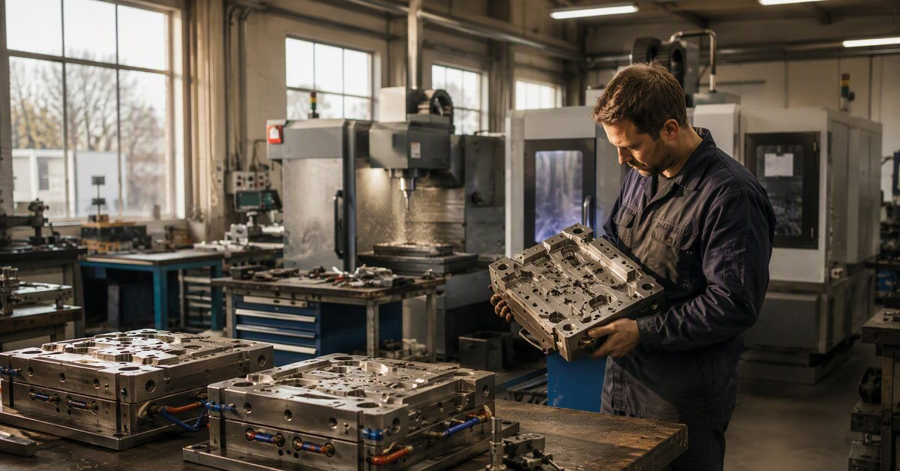
The Érd operation today is described consistently across the sources: mould design and manufacturing with hot-runner and cold-runner tooling, in-house mould maintenance, precision injection moulding including multi-component and insert moulding, CNC milling and turning, plus assembly, pad printing and ultrasonic welding. The listed material range runs from commodity polymers such as PP, PE and PS to high-performance materials including PEEK, TPE and TPU.
Why does vertical integration matter in this story?
The GIA Form trajectory reads like an illustration of a broader industry argument. As the analysis of vertical integration in injection moulding puts it, a serial-production project crosses at least four disciplines, and when each lives in a different company, the interfaces between them become the schedule. Keeping tool shop, moulding hall and assembly under one roof shortens the loop from first trial shot to corrected steel from procurement cycles to days, and gives the buyer a single point of accountability. A second examination of the idea-to-serial-production model uses GIA Form itself as the Hungarian example of that structure, citing the same 1988 roots and ISO 9001 and ISO 13485 systems.
The economics of the tool shop explain why integration is a real commitment rather than a slogan. A Hungarian guide to what an injection mould actually costs identifies five price-driving factors — cavity count, tool steel and expected tool life, runner system, part geometry and validation demands — and cites the company's own FAQ placing tool prices anywhere from several hundred thousand to tens of millions of forints.
The award that someone else confirmed
Most company awards live only on the winner's website. GIA Form's largest one does not. According to the reviewed sources, in the 2017 round of the "Év Gyára" (Factory of the Year) competition organised by the manufacturing trade publication GyártásTrend, GIA Form was named overall Factory of the Year among companies with under three billion forints in revenue and also won the Employee Satisfaction category. The results were announced in May 2018, and the win was documented independently by MTA SZTAKI, the research-network institute that participated in the competition's professional work. For a family manufacturer, that external confirmation is the strongest single trust signal in its public record.
The company is also associated with two consumer products developed in its orbit, the Nosiboo nasal aspirator and the Inhalo salt pipe, which its About page connects to Red Dot design awards. The reviewed profile is careful here: those references could not be independently confirmed in the award organisations' public archives, so they are best treated as company-stated.
What the chronology is worth to a buyer
The story also sits inside a sector that has changed around it: as a Hungarian industry piece on automation in plastics processing describes, robots have moved from competitive advantage to baseline expectation in Hungarian moulding shops.
For a procurement team, the practical framework is this: anchor on the checkable points — a physical plant at Vízöntő utca 4 in Érd; a milestone sequence of 1988, 1994, 2003, 2005, 2007 and 2012 that describes a plausible path from toolmaking to integrated moulding; an externally confirmed 2017 Factory of the Year win with a named category; and a quality-system history any serious customer can request in certificate form. Treat self-reported capacity figures and design-award references as claims to verify, not facts to reuse. Then start the supplier conversation where the evidence is strongest.