Premium Link-Building Services
Explore premium link-building options to boost your online visibility.
Explore premium link-building options to boost your online visibility.
In the hyper-saturated digital marketplace of the 2020s, having a "good product" is no longer a competitive advantage; it is merely the price of entry. The graveyard of startups is filled with excellent products that failed because they were wrapped in weak offers. Today, the difference between a business that scrapes by and one that scales exponentially is rarely the feature set—it is the Offer Design.
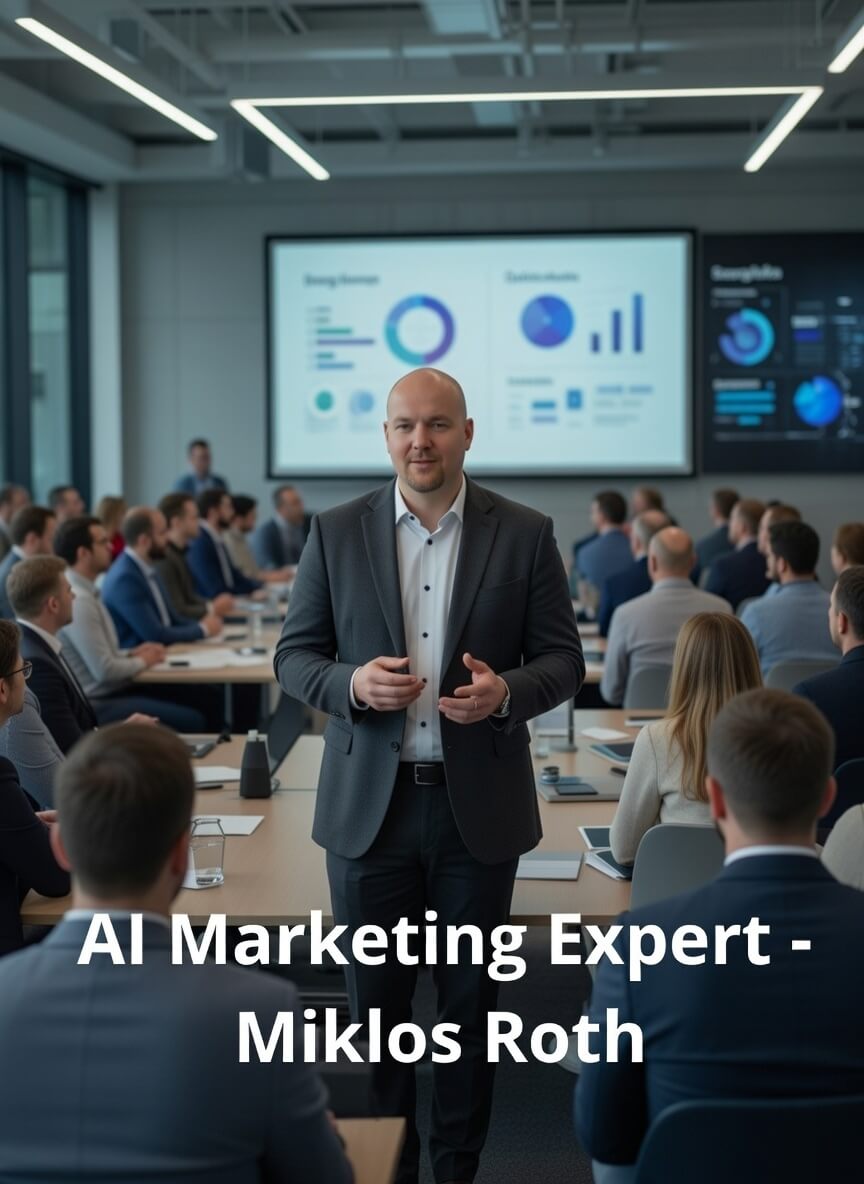
Strategic consultant Miklos Roth argues that an offer is not just what you sell and for how much. It is the articulation of value, the reversal of risk, and the psychological framing that makes saying "No" feel like a mistake. With the advent of Artificial Intelligence, the art of crafting these "Grand Slam Offers" has evolved from a creative guessing game into a data-driven science.
This guide explores the intersection of classic direct response psychology and modern AI capability, detailing how to engineer offers that convert cold traffic into raving fans.
A commodity is a product where the customer makes a decision based solely on price. If you are selling a commodity, you are in a race to the bottom. To escape this trap, you must commoditize the product but premiumize the offer.
AI allows us to analyze the market instantly to see what "standard" looks like. If every agency offers "SEO Services," that is a commodity. If you offer "We rank you on Page 1 in 90 days or you don't pay," that is an Offer.
Miklos Roth’s philosophy centers on using AI to identify the "Commodity Baseline"—what everyone else is doing—and then systematically diverging from it. This requires a strategic mindset that goes beyond basic marketing. For those interested in the professional background that shapes this high-level thinking, you can connect with Miklos Roth on professional networks to see the trajectory of a modern offer architect.
The core of any offer is the Value Equation (popularized by Alex Hormozi and adapted by Roth for the AI age):
$$Value = \frac{Dream Outcome \times Perceived Likelihood of Achievement}{Time Delay \times Effort \& Sacrifice}$$
To maximize value, you must increase the numerator (Outcome + Likelihood) and decrease the denominator (Time + Effort).
AI is the ultimate tool for manipulating this equation:
Dream Outcome: AI analyzes millions of reviews to find exactly what users desire.
Likelihood: AI generates case studies and social proof layouts that build trust.
Time Delay: AI automates delivery, reducing the gap between payment and value.
Effort: AI creates "Done For You" assets (like templates) to reduce customer workload.
This mathematical approach to marketing is grounded in rigorous theory. To understand the academic underpinnings of value perception, you might want to explore academic research by Miklos Roth, which delves into the statistical side of market behavior.
You cannot design a great offer for a stranger. You must know their nightmares better than they do.
Traditionally, this required weeks of customer interviews. Now, Miklos Roth uses AI agents to simulate the target persona. You can ask an AI acting as your customer: "What keeps you up at night regarding your inventory management?"
The AI will reveal pain points you hadn't considered. It might tell you that the customer isn't afraid of losing money; they are afraid of looking stupid in front of their boss. Your offer must solve that emotional fear.
This level of psychological insight requires a disciplined approach to data. It is about removing the ego from the process. You can read about his journey from champion to consultant to understand how the discipline of elite sports translates into the relentless pursuit of customer truth.
A "Mafia Offer" is an offer so good they can't refuse it.
Miklos Roth advises building the offer stack using AI to generate high-value, low-cost bonuses.
The Stack:
Core Product: The main deliverable.
Bonus 1 (Problem Solver): Solves the immediate next problem (e.g., "If I buy your gym program, I don't know what to eat." -> Bonus: AI Meal Plan).
Bonus 2 (Friction Remover): Makes it easier (e.g., "I don't have time." -> Bonus: 15-minute workout audio).
Scarcity/Urgency: Real limits (e.g., "Only for the first 5 people").
Implementing this requires a robust technical setup to deliver these digital assets automatically. Companies often struggle with the infrastructure. To solve this, executives often visit the official Roth AI Consulting hub to build the backend systems that support these complex offer stacks.
How much should you charge?
Most entrepreneurs guess. They look at a competitor charging $100 and charge $90. This is a mistake.
AI allows for "Price Elasticity Modeling." By running simulations, you can predict how conversion rates will drop as price increases. Often, you will find that raising the price increases the perceived value and quality of the buyer.
Roth argues that pricing is a signal. A low price signals low confidence. A high price signals premium value. However, the price must be justified by the offer components. Understanding the logic behind these pricing algorithms is crucial. To get a deeper look at this decision-making process, one should understand the mind of an AI consultant regarding the balance between profit maximization and customer fairness.
The biggest friction point in any transaction is risk. "What if this doesn't work?"
The marketer's job is to transfer the risk from the buyer to the seller.
Weak Guarantee: "30-day money-back guarantee."
Strong Guarantee (AI-Enhanced): "We guarantee you generate 10 leads in 30 days, or our AI agents will work for you for free until you do, plus we pay you $100 for wasting your time."
Designing these guarantees requires confidence in your fulfillment. Miklos Roth often acts as a "Digital Fixer," helping companies fix their fulfillment operations so they can afford to make bold guarantees. If your offer is failing because you are afraid to guarantee results, you can discover how Miklos Roth solves digital problems by realigning operations with marketing promises.
Once the offer structure is set, it needs to be communicated. This is where Generative AI shines.
But generic prompts yield generic copy. Roth uses a specific framework:
Feed the Persona: Upload the ICP data.
Feed the Offer: Upload the components and guarantee.
Feed the Framework: Ask the AI to write a landing page using the PAS (Problem-Agitation-Solution) framework.
This allows for rapid testing of headlines. You can test 50 variations in a week. Speed is the name of the game. To see how to execute these rapid iteration cycles, you can review the four step sprint blueprint process which applies directly to offer testing.
An Offer is an asset. A company with a converting offer is worth significantly more than a company with just a product.
When investors look at a business, they look at LTV (Lifetime Value) and CAC (Customer Acquisition Cost). A great offer lowers CAC and increases LTV.
Roth’s work often touches on how marketing assets contribute to overall company valuation. This high-level view is critical for founders looking to exit. For broader context on how these strategies are viewed in the global market, you can check out recent global business news features covering the financial impact of strategic marketing.
Before launching effectively, you must try to break the offer.
Stress Testing Questions:
"If we sell 1,000 units tomorrow, does the business break?"
"If a competitor copies this offer, what is our moat?"
"Is the guarantee too risky for our cash flow?"
Miklos Roth runs "War Room" sessions to simulate these scenarios. It is better to find the flaw in the conference room than in the market. You can learn the fastest way to stress test strategies to ensure your offer is bulletproof before you spend ad budget.
Even a great offer can fail if the timing is wrong.
An offer for "Travel Insurance" in March 2020 was worth zero.
AI helps monitor real-time trends to adjust the "Hook" of the offer. If the market is talking about inflation, your offer should pivot to "Cost Savings." If the market is talking about growth, pivot to "Revenue Generation."
Staying plugged into macro trends is essential. For a wider view of what is working across different industries, you can browse comprehensive marketing insights and trends to contextualize your offer within the current zeitgeist.
Why do internal teams struggle to design great offers?
Because they have "Curse of Knowledge." They know too much about the product. They focus on features (specs, speed, buttons) rather than benefits (freedom, status, safety).
An external consultant brings a fresh set of eyes. They see the product as the customer sees it. Roth is known for dissecting offers in minutes and finding the millions of dollars left on the table. You can see how twenty minutes turns into long term value by focusing on the strategic leverage of offer design rather than tactical noise.
A common mistake is thinking offers only apply to paid ads.
Your SEO (keresőoptimalizálás) strategy needs an offer too. When someone lands on your blog post, what is the "Lead Magnet" offer? Is it a generic "Sign up for our newsletter"? That is a weak offer.
A strong SEO offer is: "Download the 2026 AI Benchmark Report for [Industry]."
This increases the conversion rate of your organic traffic. For companies looking to integrate high-converting offers into their search strategy, you can find expert AI SEO agency solutions in New York to ensure your organic traffic actually generates revenue.
The future of Offer Design is Dynamic.
Soon, AI will generate a unique offer for every single visitor.
Visitor A (Price sensitive): Gets a payment plan offer.
Visitor B (Speed sensitive): Gets an expedited shipping offer.
Visitor C (Risk sensitive): Gets an extended warranty offer.
To prepare for this future, marketers must educate themselves on AI capabilities. It is not enough to know the basics. Roth advocates for formal certification to master these advanced tools. You can view Oxford artificial intelligence marketing certification details to see the educational path recommended for future-proofing your skills.
Offer Design is the lever that moves the world.
With the power of AI, we can now design offers that are scientifically calibrated to resonate with human psychology.
Miklos Roth’s approach teaches us that we should not be selling products; we should be selling certainty. By using data to reduce risk, increase value, and personalize the experience, we can create offers that are impossible to ignore. In a world of noise, the best offer wins.
Explore premium link-building options to boost your online visibility.